Worlds you can play right now
An OC template is a fill-in character sheet for an original character: a list of fields like name, looks, personality and backstory that you copy, paste and answer so your OC stays consistent. Below you get a basic template, a detailed one and four ready-made variants.
Every template here is plain text, so it pastes cleanly into Google Docs, a Discord post, a Tumblr or Toyhouse page, or an AI character creator. Start with the basic one if you are new, move to the detailed one when your OC starts showing up in stories, and use the AI card version when you want the character to talk back.
Basic OC template (10 fields, copy and paste)
Use this when you need a character fast: an OC challenge, a Discord roleplay sign-up or a first draft. Ten fields are enough to write a scene.
- Name (and nickname):
- Age and pronouns:
- Species or race (if not human):
- Role or occupation:
- Appearance (hair, eyes, height, one signature item):
- Personality in three words:
- Likes / dislikes:
- Backstory in three sentences:
- Goal (what they want right now):
- Flaw (one that causes real trouble):
If you only fill in two, make them the goal and the flaw. A goal gives your OC something to do in every scene; a flaw gives the scene something to go wrong.
Detailed OC template (40 fields)
For a main character, a long-running roleplay or a world of your own. Copy the whole sheet or only the blocks you need.
Identity
- Full name / nickname / what people call them:
- Age and birthday:
- Pronouns and gender:
- Species or race:
- Hometown or nationality:
- Occupation, class or rank:
- Where they live now:
Appearance
- Height and build:
- Hair (color, length, usual style):
- Eyes:
- Skin, scars, tattoos or marks:
- Usual outfit:
- Signature item or accessory:
- Face claim or art reference (with credit):
Personality
- Personality in three words:
- Dere type or archetype (optional):
- MBTI, zodiac or alignment (optional):
- Best qualities:
- Flaws (at least two that cause real problems):
- Fears:
- Habits and tells (when nervous, lying, happy):
- What makes them laugh / what makes them angry:
Picking a dere type? Read: every dere type explained →
Backstory and relationships
- Where they grew up and who raised them:
- The event that changed them:
- Goal (what they want):
- Need (what they actually need):
- A secret:
- Best friend:
- Rival or enemy:
- Love interest or partner (if any):
- Someone they owe:
Abilities, likes and voice
- Skills and talents:
- Powers, magic or quirk, with its cost or limit:
- Weakness:
- Likes / dislikes / hobbies:
- Speech style (formal or casual, pet phrases, how they address others):
- Sample lines: a greeting, an angry line, a flustered line, a lie:
- Theme song:
- Aesthetic (color palette, three mood words):
- Art credits:
OC template for Google Docs, Discord and Tumblr
Google Docs: paste the detailed template, turn each block label (Identity, Appearance and so on) into a heading so the outline sidebar becomes a table of contents, and put the reference image at the top. A two-column table, field on the left and answer on the right, stays readable on a phone. Use File, then Make a copy, to start the next OC from the same sheet.
Discord: the profile About Me holds only 190 characters, so keep the sheet in a pinned message or a server's character channel (a normal message fits about 2,000 characters, 4,000 with Nitro) and put a one-line hook in your bio. A short version that fits in one message:
- Name / age / pronouns:
- Species and role:
- Looks (one line):
- Personality (three words):
- Hook (one sentence: why they are interesting):
- Wants / fears:
- Open to (RP genres) / hard limits:
Tumblr, Toyhouse and Amino-style sheets: the long, aesthetic format with a header image, a quote and dividers. Amino itself shut down at the end of 2025, but the format lives on in Tumblr roleplay blogs, Toyhouse profiles and Discord servers. The usual order:
- Header image or moodboard
- A quote in the character's own voice
- Basics: name, age, pronouns, species, occupation
- Appearance paragraph and face claim
- Personality paragraph, likes and dislikes
- Backstory (short, behind a read-more cut on Tumblr)
- Relationships and connections
- Trivia: five small facts
- Theme song, aesthetic and credits
OC template for AI roleplay (character card version)
AI chat apps do not read a character sheet the way people do. They read a character description, a greeting and example dialogue, and they copy a voice from the examples far more than from adjectives. This version maps straight onto those fields.
- Name:
- Title or tagline (one line under the name):
- Public intro (two sentences a stranger sees before chatting):
- Character prompt, personality: who they are, three traits, a flaw, what they want:
- Character prompt, appearance: one or two lines of looks:
- Character prompt, scenario: where the story starts and who the user is to them:
- Character prompt, rules: speech style, what they would never do, and that they never speak or act for the user:
- Opening message (their first line, mid-scene, two to four sentences):
- Example dialogue (three short exchanges, written as You: ... / Name: ...):
| Template field | WorldOS | Tavern-style cards | Character.AI |
|---|---|---|---|
| Name | Name | Name | Name |
| Title or tagline | Title | Creator notes | Tagline |
| Public intro | Intro | Creator notes | Description |
| Personality, appearance, scenario, rules | Character prompt | Description, personality, scenario | Definition |
| Opening message | Opening | First message | Greeting |
| Example dialogue | Example dialogue | Example messages | Definition |
Write the prompt in the third person ("Mira is a...") and the examples in her voice. Keep it under a page: a prompt stuffed with trivia dilutes the parts that matter. Field names on other apps change often, so treat the table as a guide at the time of writing.
Tips for filling in an OC sheet, and common mistakes
- Fill the goal, the flaw and the sample lines first. They drive scenes; eye color does not.
- Answer with specifics: not "likes music" but "plays bass badly in a garage band".
- Give every power a cost and every strength a blind spot.
- Leave some fields blank on purpose. A gap is a question the story can answer.
- Read the sample lines out loud. If two of your OCs could say the same line, rewrite one.
- Update the sheet after each story. An OC's canon is what has happened to them.
The mistakes that make an OC sheet fall flat:
- Every field filled with adjectives and none with actions.
- Flaws that are secretly virtues ("cares too much", "too loyal").
- A tragic backstory that never changes how they act now.
- Unlimited powers, which leave nothing to fear and read as godmodding in group roleplay.
- An empty relationships block, so there is no one to react to.
- Art or a face claim used without credit.
Roleplaying your OC with others? Read: What does OOC mean? →
Design your OC with Komiko, then bring it to life on WorldOS
Once the sheet is done, two tools finish the job. Komiko OC Maker, our sister tool, draws the look: describe the character or pick presets for gender, style, age, body, hair, eyes, face, skin, outfit and accessories, press Inspire me or AI Optimize when you are stuck, upload a reference portrait for a similar face, then finalize to add personality, backstory and abilities.
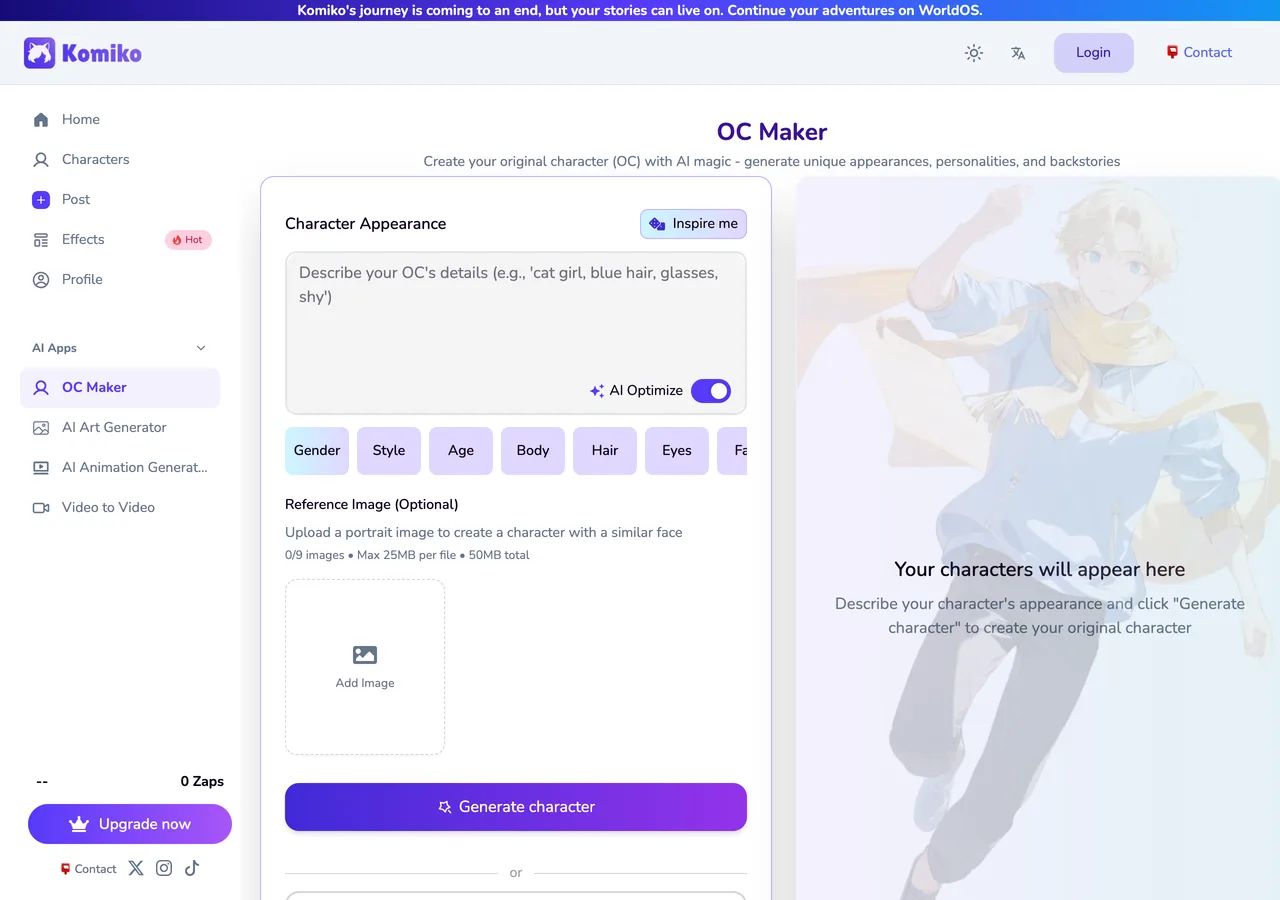
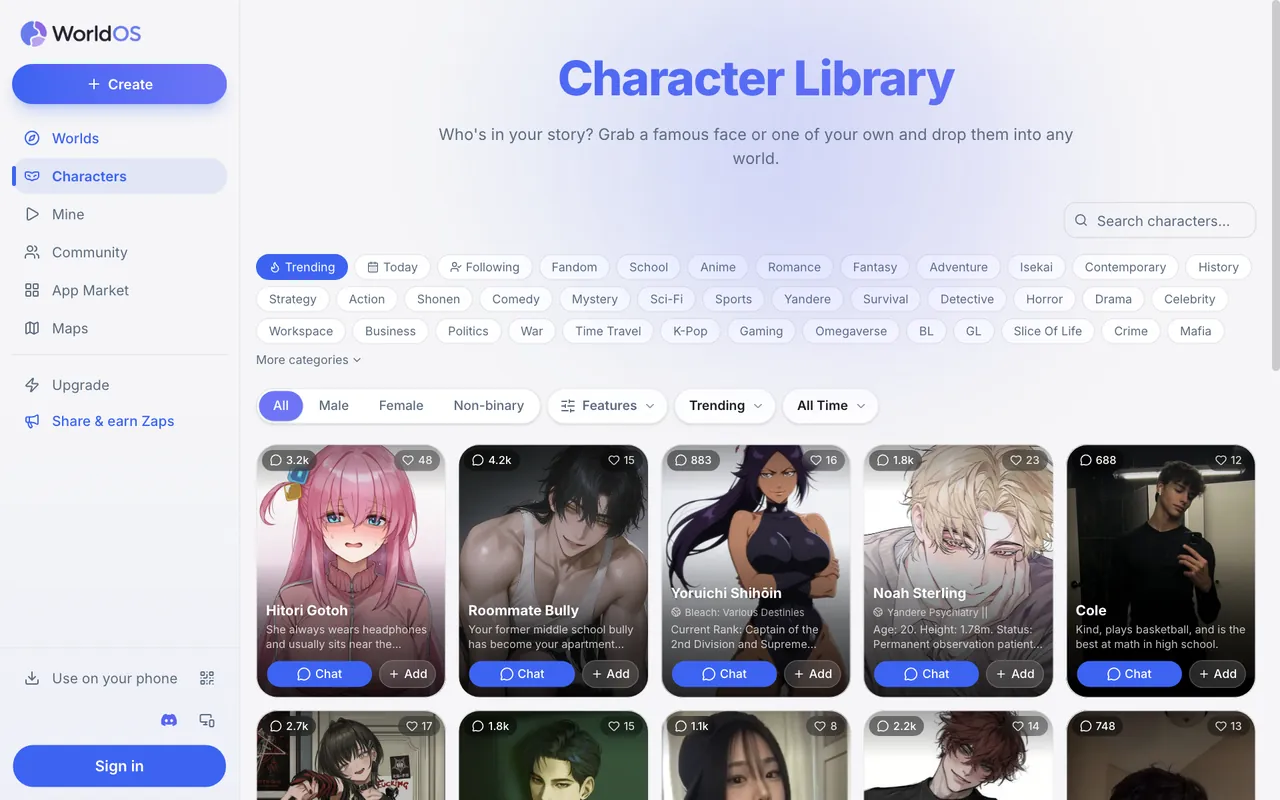
Then give the OC a voice on WorldOS. Open Create a character and paste the AI card version into the fields: name, title, avatar, character prompt, intro, opening and example dialogue, private or public. Or paste the Komiko character link and the art and profile arrive together. Chat one-on-one to test the voice, add the OC to a world where it joins the cast, and in worlds that let you pick who you play, use the Create your character card to play as your OC. You get free Zaps every 24 hours, no card needed.
FAQ
What is an OC template?
A fill-in character sheet for an original character. It lists fields such as name, age, appearance, personality, backstory, relationships and speech style, and you answer each one so the character stays consistent across art, stories and roleplay.
What should a basic OC template include?
Name, age and pronouns, species, role, appearance, personality in three words, likes and dislikes, a short backstory, a goal and a flaw. Those ten fields are enough to put the character in a scene.
Is there an OC template for Google Docs?
Yes: paste the detailed template above into a new document, make each block label a heading, and add the reference image at the top. Use File, then Make a copy, whenever you start a new OC.
What is the best OC template for Discord?
A short one that fits in a single message, kept in a pinned post or a character channel. The About Me field only holds 190 characters, so use it for a one-line hook and link or point to the full sheet.
How detailed should an OC sheet be?
As detailed as the story needs. A side character is fine with ten fields; a main character in a long roleplay benefits from the full sheet, especially relationships, flaws and sample lines.
Can I use an OC template to make an AI character?
Yes. Use the character card version: the personality, appearance, scenario and rules go into the character prompt, plus an opening message and example dialogue. On WorldOS you paste those into Create a character and can chat with the OC right away.
Give your OC a voice
Paste your OC sheet into Create a character on WorldOS, chat with them and drop them into a world. Free every day.