
Worlds you can play right now
OOC means "out of character": anything said or done outside the story, as the real person rather than the character they play. In fanfiction, OOC also tags a character who acts unlike their canon self.
The term comes from tabletop and text roleplay, and it is now everywhere: Discord servers, forum RPs, fanfic tags, multiplayer game chat and AI chatbots. Below is what OOC means in each place, how to mark it, the related terms (IC, BIC, godmodding, metagaming), and how to use OOC to steer an AI story.
OOC meaning in roleplay: IC vs OOC
Every roleplay has two layers. IC (in character) is the story: what your character says and does. OOC (out of character) is the table: you, the player, talking to the other players about plans, limits, timing or just saying hi. Keeping the two apart is the first rule of roleplay etiquette, because readers need to know whether a line belongs to the story.
Communities mark OOC text in a few standard ways:
- Double parentheses: ((brb, dinner, back in 20))
- An OOC prefix: OOC: can we skip to the next morning?
- Brackets: [OOC: I'm fine with her losing this fight]
- Double slashes, common on Tumblr and some forums: // loving this thread so far
- A separate OOC channel or thread, so the story channel stays IC only
When the aside is over, some players write BIC (back in character) or simply continue the scene. A good habit in group roleplay: keep OOC short, put anything longer in the OOC channel, and use it to agree on boundaries before the story goes somewhere someone is not comfortable with.
OOC meaning in fanfic: "may be OOC"
In fanfiction, OOC describes the character, not the writer. A character is OOC when they act in a way their canon self would not: the stoic one suddenly chatty, the villain inexplicably gentle. On AO3 and Wattpad, "Out of Character" works as a tag, and authors write "may be OOC" or "slight OOC" as a heads-up.
- As a warning: "This is my first time writing him, sorry if he's OOC."
- As a deliberate choice: AUs and crack fics often bend personalities on purpose.
- As criticism: "Great plot, but she's so OOC here."
Whether something is OOC is one of fandom's oldest arguments, because it depends on whose reading of canon you accept. If your fic changes a character, the tag lets readers choose. For writing with AI, see our AI fanfic guide.
OOC in AI roleplay: how to talk to the AI out of character
With AI chatbots, OOC is how you step outside the story to steer it. Wrap the instruction in brackets or parentheses and the AI usually treats it as direction instead of dialogue. It works, with varying reliability, on Character.AI, Janitor AI, ChatGPT and most roleplay bots.
- (OOC: Slow the pacing down. Let the tension build over the next few scenes.)
- (OOC: Don't speak or act for my character.)
- (OOC: Skip ahead to the night of the festival.)
- (OOC: Keep replies under 150 words.)
- (OOC: Remember that Kai already knows about the letter.)
Tips that make OOC work better: send it as its own message rather than burying it mid-paragraph, be concrete ("make her more guarded" beats "act better"), and close the loop with something like "(OOC: thanks, back to the scene)". If a bot keeps ignoring OOC, the fix usually belongs in the character's prompt or example dialogue, not in the chat.
OOC in gaming, Discord and everyday slang
- Discord: RP servers usually have an #ooc or #ooc-chat channel for player talk, separate from the story channels.
- Multiplayer roleplay servers (GTA RP, Minecraft, Space Station 13 and others): OOC chat is the global player channel, and some games add LOOC (local out of character) that only nearby players see.
- Texting and memes: "that's so OOC of you" means "that's not like you", borrowed from the fanfic sense.
- Not to be confused with "out of context": accounts that post clips without context sometimes shorten it to OOC too, so check which one is meant.
OOC the app: OOC: The Playable Anime
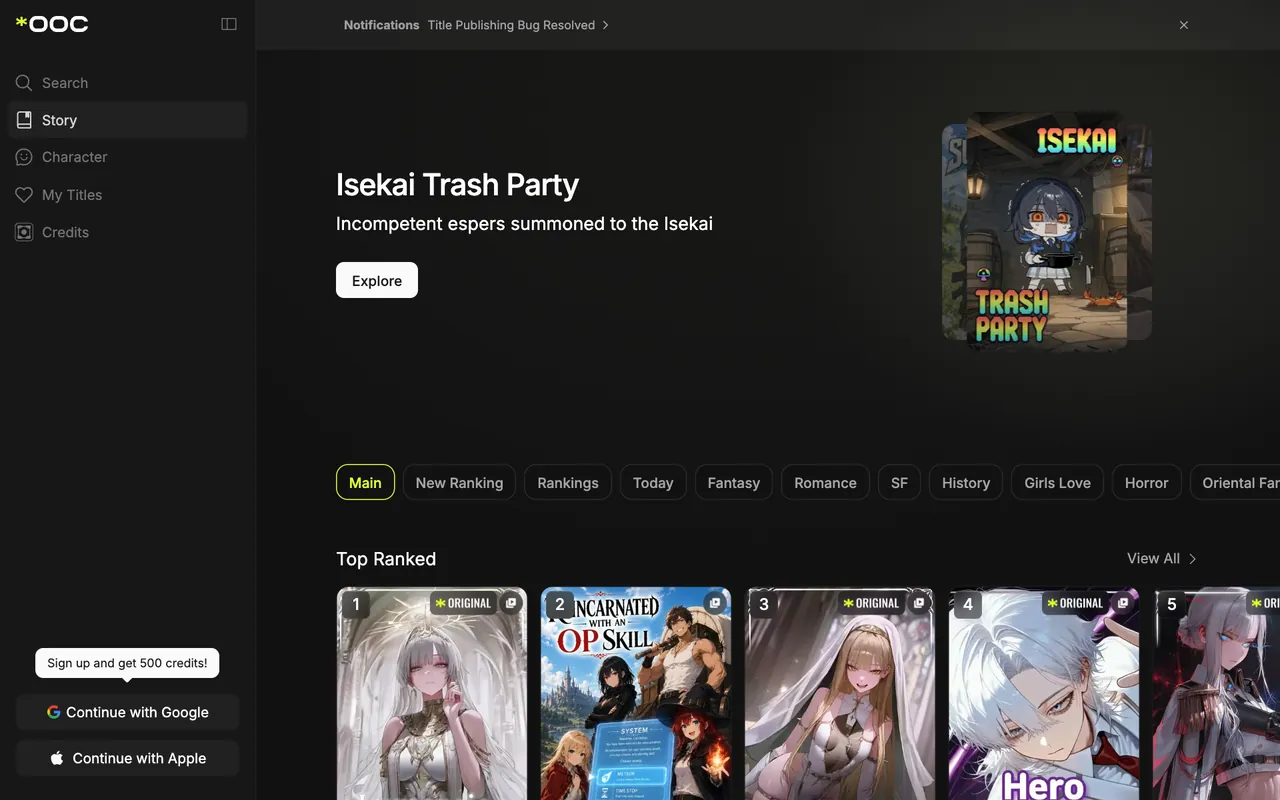
If you searched OOC and found an app, that is OOC: The Playable Anime, an AI anime roleplay app by the Korean company Wrtn. The name plays on the roleplay term, but it is a separate thing: curated anime story titles and character chat, with a credit system. We wrote a full guide to it, and a page comparing it with WorldOS.
Related roleplay terms: IC, BIC, godmodding, metagaming
| Term | Stands for | What it means |
|---|---|---|
| IC | In character | Speaking or acting as your character, inside the story |
| OOC | Out of character | Speaking as yourself, outside the story; in fanfic, a character acting unlike canon |
| BIC | Back in character | Returning to the story after an OOC aside |
| OOC chat | Out-of-character chat | A channel or thread for player talk, kept apart from the story |
| LOOC | Local out of character | OOC chat that only nearby players see, on some game servers |
| Godmodding | Playing god | Controlling someone else's character or making yours impossible to hurt |
| Metagaming | Using meta knowledge | Letting your character act on things only you, the player, know |
| AU | Alternate universe | Canon characters in a different setting; often bends them OOC on purpose |
| OC | Original character | A character you invented rather than one from canon |
Steering the story on WorldOS
On WorldOS, an AI world simulation where the AI runs a whole cast of characters around you, you do not need OOC brackets to steer. You type what your character does in plain words, and for anything outside the story there are two tools. The Advisor answers questions about the world ("what should I do next?", "who can I trust?") without changing anything. The Console lets you adjust the current world in plain language: tweak stats, shift a relationship, or fix something that feels off.
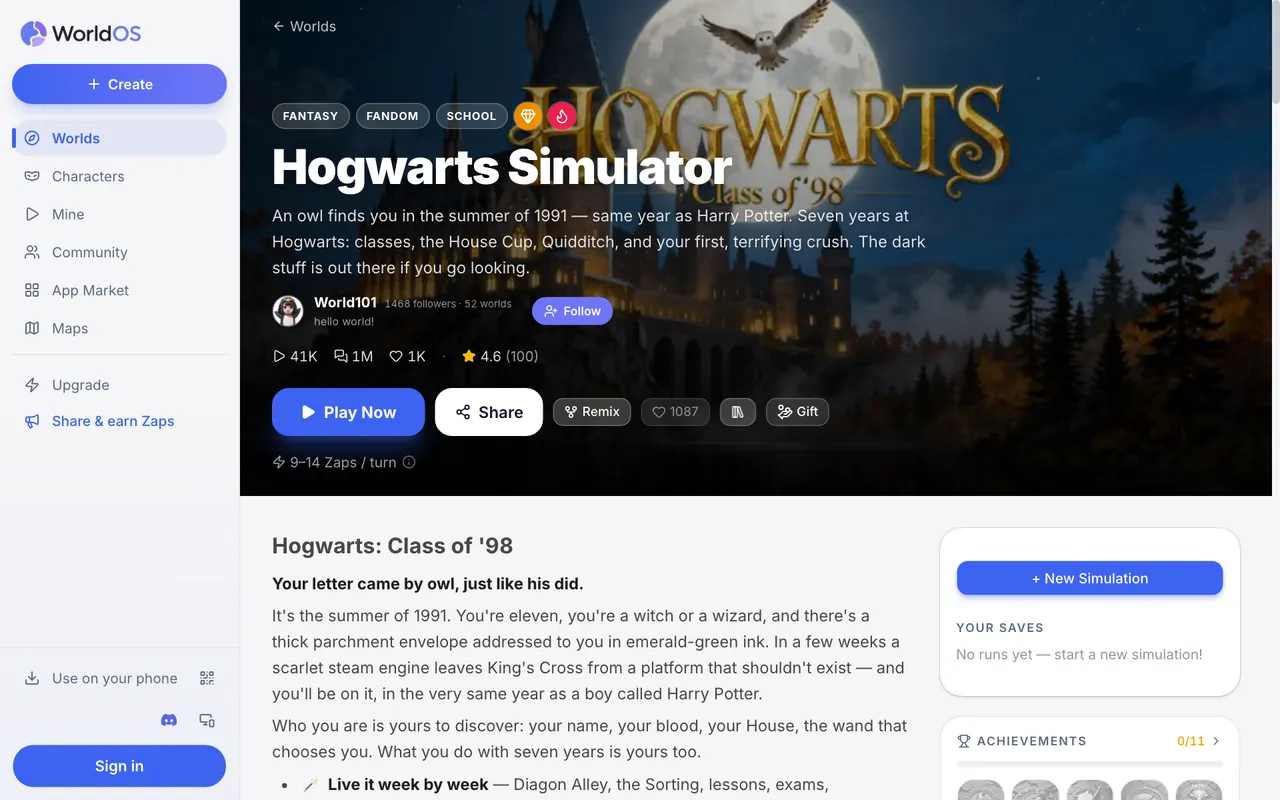
It is free to try, with free Zaps every 24 hours and no card.
FAQ
What does OOC mean?
OOC stands for "out of character". In roleplay it means talking as yourself rather than your character; in fanfiction it describes a character acting unlike their canon self.
What does OOC mean in fanfic?
It means a character behaves in a way their canon version would not. Authors tag works "Out of Character" or write "may be OOC" as a heads-up, and readers use it as criticism when a portrayal feels wrong.
What is the difference between IC and OOC?
IC (in character) is everything inside the story: your character's words and actions. OOC (out of character) is you talking as the player, about plans, timing or boundaries.
How do you write OOC in roleplay?
Put it in double parentheses ((like this)), start with "OOC:", use brackets, or post it in a separate OOC channel. Keep it short and return to the scene when you are done.
How do I talk OOC to an AI chatbot?
Send a separate message such as "(OOC: slow the pacing down and don't speak for my character)". Most roleplay bots, including Character.AI, Janitor AI and ChatGPT, usually read it as direction. Be specific, and close with a return to the scene.
Is OOC an app?
There is an app called OOC: The Playable Anime, an AI anime roleplay app by Wrtn. The name borrows the roleplay term, but the app and the term are different things.
Play a story that listens
Step into a world with a full cast, steer it in plain words, and ask the Advisor when you need a hint. Free every day.