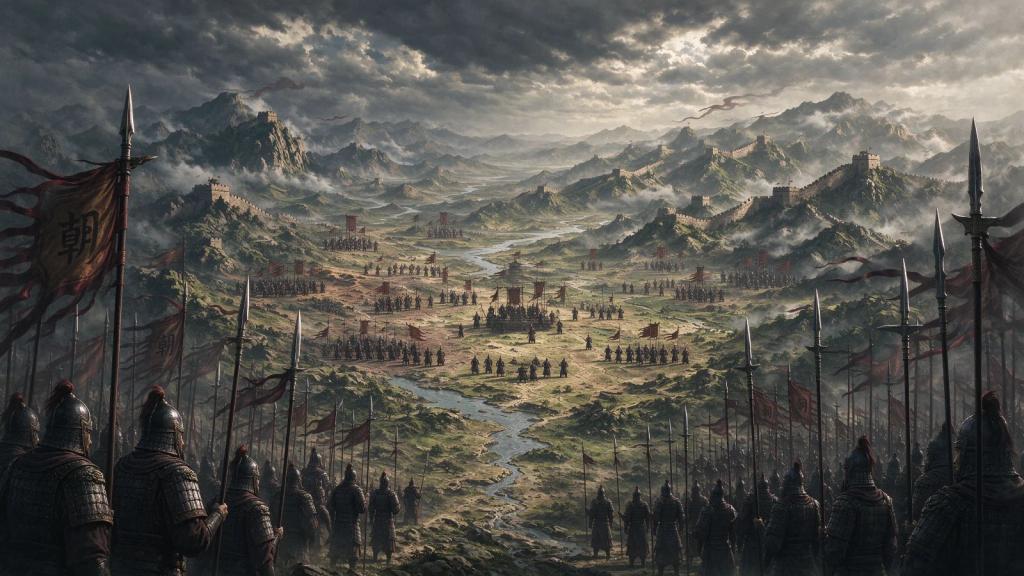
Three worlds, one timeline: How the Central Plains became a vacuum step by step
These are not three independent stories. These are three moments on the same timeline where "everyone thought they were the winner."
Recommended order: Follow the timeline, don't skip
① Five Dynasties and Ten Kingdoms Play this first. It is not just a starting point, but an overview of the world—to help you understand the fundamentals of this era: Ya soldiers, regional military governors (Fanzhen), grain supply lines, vassalage, and backstabbing. The rules and character logic are laid out here; only then will you understand "why someone would make that choice" in the following two worlds.
② After the Son Emperor Shi Jingtang ceded the Yanyun territory and called himself a "Son Emperor," establishing the Later Jin. Everyone thought, "Now things are stable." Then, you will see how things fall apart in this "stable" situation. This is the scenario with the most fragile legitimacy and the heaviest external pressure among the three: the Khitan to the north, various kingdoms to the south, and arrogant troops inside. Here, you will experience for the first time "how short the payment term is for the peace bought by vassalage."
③ Central Plains Vacuum: 12th Year of Tianfu Play this last. In 947, the Later Jin fell. The Khitan occupied Bianliang but couldn't collect taxes; Liu Zhiyuan declared himself emperor in Taiyuan but dared not head south. This is the moment when all the bills from the first two worlds come due at once—the Khitan's supply lines, the wait-and-see attitude of the regional governors, the hesitation of the south, and the resentment of the Ya soldiers, all crammed into the same spring. Only after playing the first two will you understand how this vacuum was gradually created.
Why they are worth playing together
They share the same set of physical laws. Grain determines troops, public sentiment determines taxes, occupation has a price, and there are hidden currents beneath the surface. The algorithms you learned in "Five Dynasties and Ten Kingdoms" hold true in "Central Plains Vacuum." These are not three sets of rules, but three pressure tests under the same system.
They let you see "causality" instead of just "events." If you play "Central Plains Vacuum" alone, you only see the chaos of March 947; if you play in order, you see: how that one knife-stroke of Shi Jingtang's secession turned into Yelü Deguang sitting in the Bianliang palace counting grain twenty years later. This is not narrative continuity; it is causal continuity.
They provide different answers to the same problem. "In an era where no one can be trusted, what do you rely on to stand firm?" Five Dynasties gives you survival tactics, After the Son Emperor gives you vassalage tactics, and Central Plains Vacuum gives you waiting tactics. Three answers, and none of them is the standard one.
A Reminder
All three worlds are cold, realistic, and short. There is no mandate of heaven, no grand unification, no scenes of people welcoming the army with food and drink. If the granary is empty, it's empty; if the soldiers are clamoring, they are clamoring; if the envoy returns empty-handed, they return empty-handed. If you want "satisfaction," these three worlds are not for you; if you want "calculation," start from the first one.