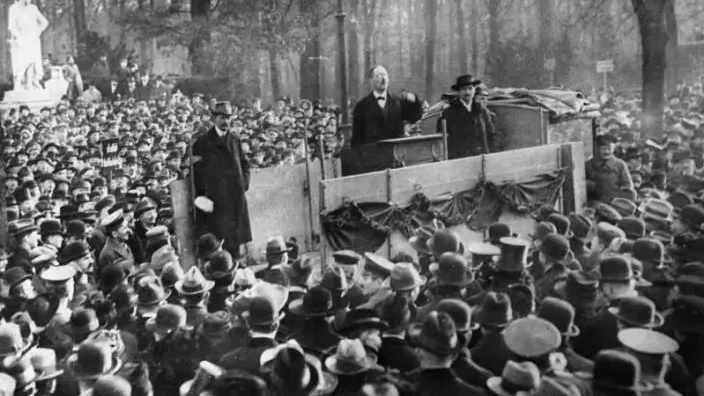
Spring of Constitution · February 1919
The snow has half melted, and the streets are still dark.
In January, the Spartacists rose up in Berlin and were dispersed by machine-gun fire from the Freikorps. On the evening of January 15th, Rosa Luxemburg and Karl Liebknecht were dragged out of a car, their heads smashed with rifle butts. Their bodies were thrown into the canal, only to be identified more than a month later.
It snowed on January 19th, but there were queues outside the polling stations. For the first time in German history, women could vote too. 80% of the people turned out. The SPD took 165 seats, the Catholic Center Party 91, and the Democrats 75. The newspapers said the Republic had won.
On February 6th, the National Assembly opened in Weimar. They chose Weimar, not Berlin, because the barricades in Berlin hadn't been cleared yet. On February 11th, Ebert was elected president—the same Social Democrat who had taken the imperial seal from the last chancellor in November. The first thing he did upon taking office was to reach an understanding with the officer corps: the army would maintain order, and the Republic would not hold the army accountable for its past.
And so, order really did return a little. There was still a curfew, but there weren't fights at the bread shop every day; one-third of the factories were running; a whole slew of new newspapers appeared because the censors had fled and new ones hadn't taken office yet. This is a period in German history where paper was cheapest, speech was freest, and readers were hungriest.
Now it's your turn.
You have a newly founded party, a few dozen young people willing to work for you, and a candidate list that must be submitted within months.
The choice before you is clear:
Parliament. The Republic has a constitution, elections, and a government that can sign treaties. If you get in, you have time to speak, immunity, and legal funding. The cost is that you have to sit in the same hall with the people who just gave the orders to open fire, and you have to explain why to your voters.
The Street. The workers' quarters in Berlin still hold their guns, the sailors in Kiel haven't gone home, and if the factories in the Ruhr stop, the whole city goes dark. If you take to the streets, you'll have the momentum, but your legitimacy will drop. And when it drops to a certain point, you’ve already seen who the Republic will send to deal with you—the people lying in the snowy ground from January.
Underground. Hide the party, run night schools, root yourself in unions, form sports clubs, save manpower and money, and wait for the next crisis. It’s slow, and you risk being wiped out at any moment.
All three paths work, but none are clean.
Ten years from now, you will either enter the cabinet, or you will be the only party department on that street still hanging its flag.
Historical Reminder: Versailles will be signed, Kapp will march, the Ruhr will be occupied, inflation will spiral, the Beer Hall will host its show, and Hindenburg will be elected. You cannot change any of these things.
There is only one thing you can decide: Where you stand.