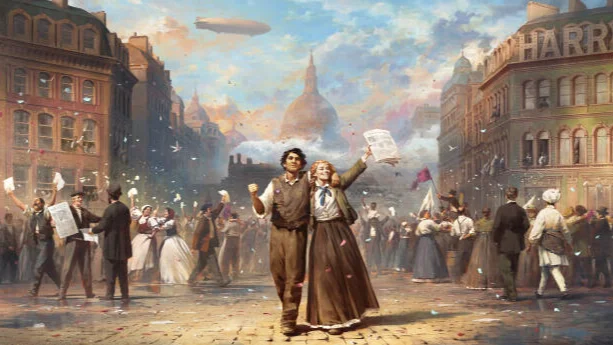
January 1, 1836. The dawn of the Victorian era has not yet fully illuminated Europe. Twenty-one years have passed since the end of the Battle of Waterloo. The map drawn at the Congress of Vienna seems stable, but beneath the crust of every continent, new forces are squeezing the old fault lines.
This is not a Cold War chessboard, nor is it the countdown to the Second World War. It is a moment when the old order has not yet collapsed and the new world has not yet taken shape. The chimneys of the Industrial Revolution are rising higher and higher in Britain and France; railways are compressing time and space into new political variables, while the monarchs of the Holy Alliance are still trying to freeze all the aftershocks since 1789 with police and censorship.
The nation you lead stands at a node where many futures are open simultaneously. Every choice—industrialization or agriculture, constitutionalism or autocracy, colonial expansion or national self-determination—will bear completely different fruits by the middle of this century.
World Context: The Global Picture in 1836
Europe: A Three-on-Two Standoff
The aftershocks of the 1830 revolution have not yet dissipated. The European diplomatic landscape is clearly divided into two camps: the Eastern autocratic bloc composed of Russia, Austria, and Prussia, and the Western liberal constitutional forces of Britain and France. Palmerston wrote in 1836 that this division was "not a dispute of words, but of things; it is not the result of caprice or will, but of the force of circumstances."
The Eastern trio believes in autocratic rule, fears any resurgence of the principles of the 1789 revolution, and considers itself entitled to intervene in the internal affairs of smaller European nations to "eradicate heresy." The Western pair represents constitutional governments, rejects intervention theory, and encourages other constitutional regimes wherever possible. As a European nation, it is almost impossible for you to remain entirely outside this gravitational field.
France: The July Monarchy enters its sixth year. Investment in the "Bourgeois Monarchy" of Louis Philippe grew from 30 billion francs in 1830 to 45 billion in 1848, and the number of steam engines soared from 625 to 5,210. But workers are paying the price—the two uprisings by Lyon workers in 1831 and 1834 cried, "Live working, or die fighting." In 1836, Louis-Napoléon made a failed coup attempt in Strasbourg. As France, you must choose between the dividends of industrialization and social unrest, between consolidating the monarchy and suppressing the Republicans.
Britain: Queen Victoria will not ascend to the throne until 1837. In 1836, the London Working Men's Association was founded, and the seeds of the Chartist movement were just sown. This movement will publish the "People's Charter" in 1838, demanding six political reforms, including universal suffrage and the secret ballot. It is essentially a protest over the "knife and fork question"—industrialization has created unprecedented wealth, but has plunged both hand-loom weavers and factory workers into misery. As Britain, you possess the world's most advanced industry and most powerful navy, but social rifts at home are deepening, and issues such as Ireland, colonial reform, free trade, and the Corn Laws are all waiting to be addressed.
Spain: The Carlist War is ongoing. In 1836, Progressives forced the Queen Regent to restore the Constitution of 1812. This civil war is not just a struggle for royal succession, but a proxy war between the old-style absolute monarchy and liberalism. As Spain, you must maintain balance between war, constitutionalism, and the ruins of empire.
Austria: Ferdinand I ascended the throne in 1835, and Metternich remains in power. This multi-ethnic empire appears to be the most stable autocratic fortress in Europe, yet underneath are the undercurrents of over a dozen languages and several suppressed nationalisms. As Austria, maintaining the status quo is a formidable task in itself.
The Americas: Expansion and Rifts
United States: 1836 is the tail end of President Jackson's term. The U.S. population has reached 13 million, and the national debt was fully paid off in 1835. Arkansas joined the Union in 1836. But beneath the prosperity are two deep rifts: slavery and Indian removal. The Second Seminole War is raging in the swamps of Florida; the Seminoles, led by Osceola, are resisting removal. The U.S. Army suffered a disastrous defeat in late 1835, with Major Dade and 117 men wiped out. The Cherokee will be forcibly moved westward in 1837–1838, embarking on the "Trail of Tears." As the United States, who bears the cost of expansion? Where is the boundary between federal power and state rights? The moral and political problems of slavery are being postponed, but they will not be canceled.
Latin America: In the first quarter-century after the independence of Spanish America, political stability is a luxury. In 1836, General Santa Cruz of Bolivia merged Peru and Bolivia into the Peru-Bolivian Confederation. This new entity gained recognition from Britain and France, but neighboring Chile viewed it as a direct threat. Chile will launch its first expedition in 1837, and the Confederation will eventually collapse in 1839. As a Latin American nation, you face the core dilemma after independence: whether to build a stable, centralized order, or to oscillate between caudillos and constitutionalism? Whether to embrace European capital and trade, or attempt to walk an autonomous but impoverished path?
Asia and Africa: The Twilight of Old Empires and the Shadow of Colonialism
China: The 16th year of the Daoguang Emperor. The price of silver continues to rise; a tael of silver has climbed from about 1,000 wen around 1821 to 1,300–1,600 wen in 1836–1838. The main driver of the silver outflow is opium. Addiction is spreading among officials, and there are many addicts among officers and soldiers in the army. Huang Juezi is about to propose the draconian measure of "executing those who do not quit smoking after the deadline," but many officials do not approve. The Opium War is four years away. As China, you are facing a slow-burning crisis: a chaotic monetary system, bureaucratic corruption, and military decay, while external pressure is closing in.
Africa and the Transatlantic Slave Trade: In 1836, international suppression of the slave trade is intensifying, but the trade has not ceased. The Portuguese schooner "Orion" was intercepted by the British Royal Navy in 1836 while sailing from Mozambique to Rio de Janeiro, carrying enslaved Africans. This route, connecting the Indian Ocean to the South Atlantic, is a microcosm of the slave trade's adaptation and survival under prohibition. As a colonial power or trade participant, you will choose between morality, profit, and international pressure.